
R On T Phenomenon Pacemaker
Set the output as low as possible. The R-on-T phenomenon is the superimposition of an ectopic beat on the T wave of a preceding beat.

Ecg And Pressure Waveform During The Second Episode Of Ventricular Download Scientific Diagram
You dont want to have any R on T phenomena - you only need to see the pacing spikes.
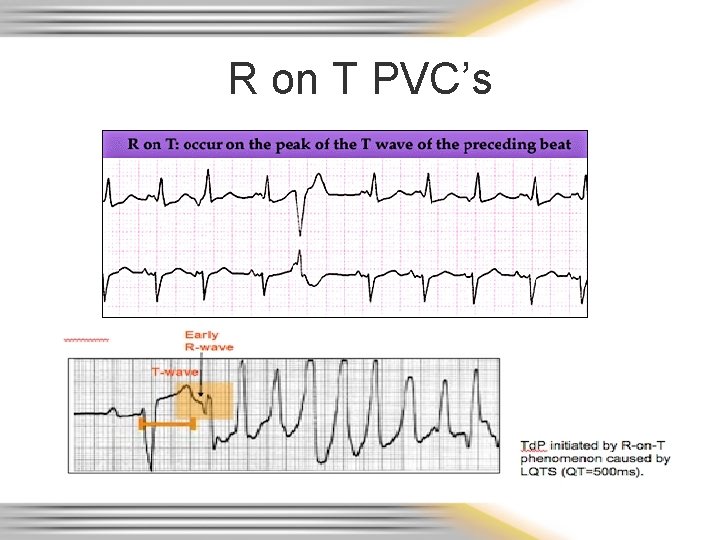
R on t phenomenon pacemaker. The R-on-T phenomenon was first described by Smirk in 1949 as R waves interrupting T waves 1. In this case we believed that the VPC triggered the non-sustained VT. However undersensing of pacing wires may cause the R-on-T phenomenon which induces ventricular fibrillation.
10 Placing a magnet on the device during the PMT will change the pacemakers mode to dual-chamber pacing mode in DOO. The repolarization of the atria is usually not visible because it occurs simultaneously as the activation depolarization of the ventricles which generates substantially larger. The R on T phenomenon although uncommon should be kept in mind if patient developed VFVT after inserting temporary pacemaker in acute inferior wall MI.
Epicardial pacemaker wire insertion is standard following cardiothoracic surgery. 23 The image presented here is taken from telemetry in the intensive care unit a few days after cardiac surgery. R on T is where the pacemaker fires and produces a QRS during the vulnerable Twave possibly precipitating ventricular tachycardia or ventricular.
The ventricle chamber is being paced regardless. Th e R-on-T phenomenon was fi rst described by Smirk in 1949 as R waves interrupting T waves 1. Pacemaker-mediated tachycardia is similar to a re-entrant tachycardia except that the pacemaker forms part of the re-entrant circuit.
This doesnt look too bad but remember that the VOO pacemaker is totally unconcerned about when it fires. The first deflection henceforth called wave is the P-wave which represents activation depolarization of the atria. Change the rate to one which is much lower than the patients native rate.
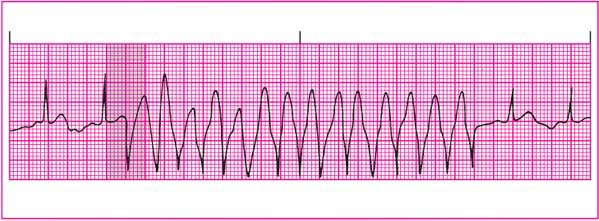
Figure 4 shows the classical ECG waveforms. Pacemaker and the intrinsic rhythm. If it happens to fire during the vulnerable period it may produce an R wave on top of a T wave the R - on - T phenomenon which will then give rise to a polymorphic VT or VF.
Risk by pacing at a higher rate of 80bpm turning this mode off ASAP when no longer needed. When the PVC falls on a T wave from the previous contraction ventricular fibrillation and death can occur. The tachycardia could therefore be avoided by programming a sufficiently long postventricular atrial refractory period PVARP.
Th e R on T phenomenon although uncommon should be kept in mind if patient developed VFVT aft er inserting temporary pacemaker in acute inferior wall MI. This risk of R on T is great and well-documented. The R-on-T phenomenon was first described by Smirk in 1949 as R waves interrupting T waves1 2 In 1966 Francois Dessertenne described a specific electrocardiographic form of polymorphic ventricular tachycardia PVT characterized by changing amplitude of the complexes with a characteristic twist around the isoelectric baseline with prolonged QT interval which he termed torsades de pointes.
Early observations suggested that R-on-T was likely to initiate sustained ventricular tachyarrhythmias. This can result in the pacemaker firing at inappropriate times and producing an R on T phenomenon. In patients with pacemakers R-on-T phenomenon can have multiple causes including pacemaker undersensing.
This occurs when a ventricular premature beat follows each normal beat. This phenomenon can occur not only in asynchronous ventricular pacemakers but also in. More recent experimental and clinical observations suggest that R-on-T is not a critical determ.
An R on T phenomenon. Typically a premature ventricular complex occurring at the critical time during the T wave of the preceding beat precipitates ventricular tachycardia and fibrillation. The phenomenon is also related to undersensing of temporary pacing wires.
In addition the most dangerous situation is called the R-on-T Phenomenon. During the T wave repolarization heart muscle is very sensitive to outside stimulus thus a strong PVC can send the myocardium into fibrillation. Ventricular fibrillation may be caused by R on T stimulation from a temporary pacemaker.
Now keep decreasing the sensitivity until the pacemaker senses every p-wave or QRS interval. This mode risks R-on-T phenomenon VF. R on T is where the pacemaker fires and produces a QRS during the vulnerable Twave possibly precipitating ventricular tachycardia or ventricular fibrillation.
R-on-T phenomenon What does the ECG show. Ventricular fibrillation in an 83-year-old man after coronary angiography was caused by the R-on-T phenomenon due to a sensing failure on the part of a temporary pacemaker with ventricular. In practice the spike is almost always delivered sooner than the repolarisation phase of a premature complex that has fallen within the blanking period.
Electro-cautery will be sensed and actioned upon - particularly for pacemaker dependent patients. The R-on-T phenomenon is a well-known entity that predisposes to dangerous arrhythmias. The R-on-T phenomenon is a well-known entity that predisposes to dangerous arrhythmias including ventricular fibrillation Vf a fatal arrhythmia.
PPJ participated in the initial management of the second patient and researched the literature for this article. Rarely they have the potential to induce ventricular fibrillation particularly if they coincide with the T wave of a preceding beat - this is described as the R on T phenomenon ventricular bigeminy. Increase the sensitivity value until no cardiac activity is sensed.
AAM was consulted in the management of both patients proposed the idea for the article and drafted the manuscript. There was a potential risk of the R-on-T phenomenon in this patient as the pacing spikes fell on the vulnerable period of repolarization which could lead to fatal ventricular arrhythmia or fibrillation. In patients with an implanted pacemaker the R-on-T phenomenon occurs when there is under-sensing of an intrinsic R wave or asynchronous pacing.
The pacemaker spike having not been inhibited could theoretically fall within the T wave of the premature beat causing R-on-T fibrillation. The incidence of the R-on-T phenomenon in patients with a pacemaker has also been previously reported by Fries et al. Indicated when wary of external electrical signals eg.

What Is R On T Phenomenon Ecg Article Blog
Ventricular Arrhythmias Anesthesia Key

Ecg And Pressure Waveform During The First Episode Of Ventricular Download Scientific Diagram

A Telemetric Monitoring Of The Initiation Of Pmvt An Inappropriate Download Scientific Diagram

Post Crt Pacing 24 Hour Holter Tracing Showing Pvc With R On T Phenomenon Download Scientific Diagram

Pacemaker Induced Ventricular Fibrillation In Coronary Care Units Abstract Europe Pmc

The R On T Phenomenon In Patients With Implantable Cardioverter Defibrillators American Journal Of Cardiology

R On T Phenomenon On Ecg Article Blog

Ventricular Arrhythmias Ppt Download
Rhythm 12 Lead Ekg Review March 2011 Ce

R On T On Ecg Article Blog

Pdf An Uncommon Cause Of Pacemaker Mediated Ventricular Tachycardia

Pacemaker Induced Ventricular Fibrillation In Coronary Care Units Abstract Europe Pmc
Prague Icu

Posting Komentar untuk "R On T Phenomenon Pacemaker"